Teamwork
Client-focused project management with built-in client portals and free collaborators
Pros
- ✓ Unlimited free client collaborators on all plans
- ✓ Mature, battle-tested platform since 2007
- ✓ Comprehensive project management beyond just portals
- ✓ Integrates with Slack, HubSpot, and 100+ tools
Cons
- ✗ Client portal is a feature, not the core product
- ✗ Can be complex for teams wanting just a simple portal
- ✗ Higher-tier features get expensive
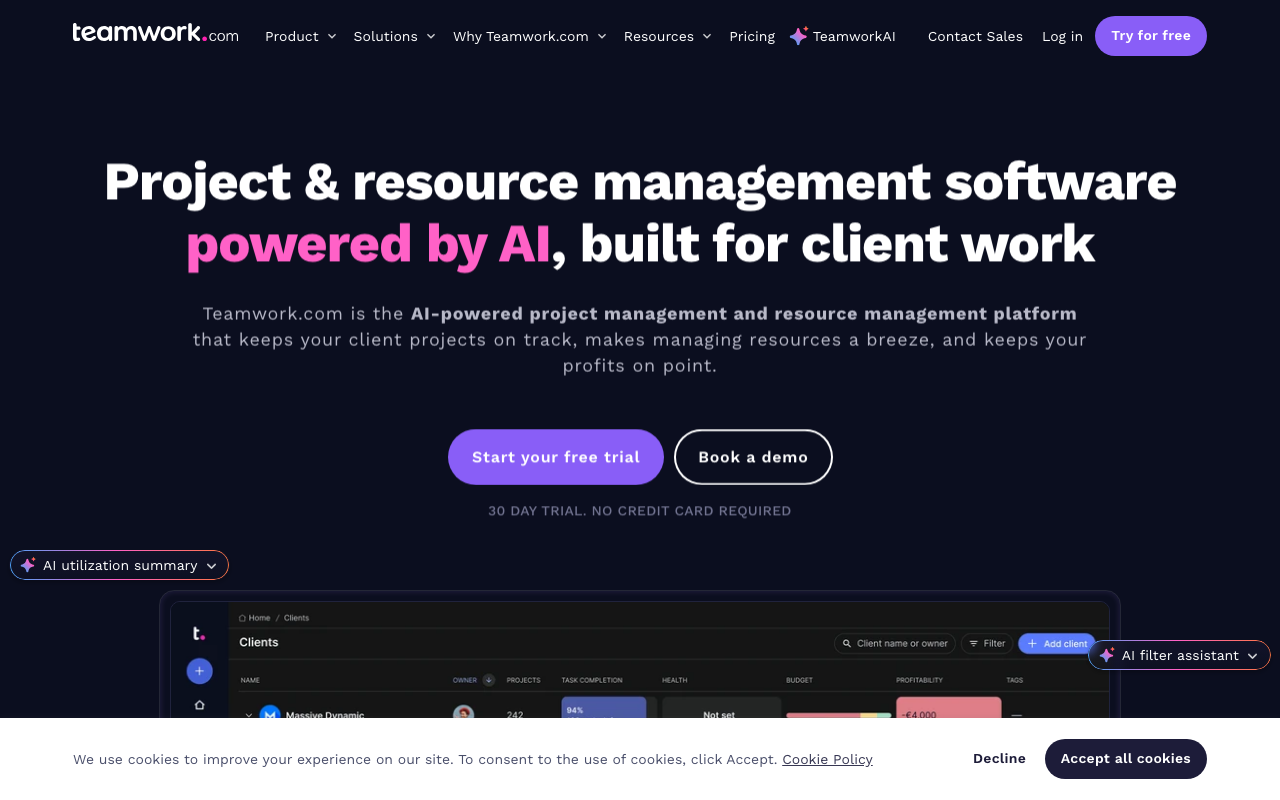
Teamwork is a project management platform built specifically for client work — agencies, consultancies, and professional services firms that need to track time, manage budgets, and keep clients in the loop without juggling separate tools. Founded in Cork in 2007, it's a mature product with over 16,000 customers and a feature set that goes well beyond lightweight portal solutions.
Client access model
Client users are free on every paid plan and unlimited on higher tiers. They can see project status, comment on tasks, approve deliverables, and access files without consuming a paid seat. This model makes Teamwork appealing for agencies with many clients — you're not paying per client contact.
The client-facing view is scoped: collaborators only see what they're explicitly given access to. The "Clients" section aggregates all projects tied to a client company, showing budget totals, milestones, and outstanding action items in one place.
Project management depth
Teamwork covers the full project management stack: List, Table, Board, and Gantt views; subtasks, dependencies, and milestones; intake forms that convert submissions into tasks; if/then (and on higher plans, if/and/or/then) conditional logic for automations; and role-based permissions. Template libraries let teams templatize entire projects or task lists.
Time tracking is built in, not bolted on. Teams can log time against tasks, track billable vs. non-billable hours, set user rates, and manage retainers. Budget types include time-based, financial, and fixed-fee — each with limits that scale by plan. Profitability reporting and utilization dashboards let agency owners see margin in real time.
Resource management includes workload scheduling, time-off tracking, and tentative project forecasting. On Grow and above, advanced resource scheduling unlocks.
AI features (TeamworkAI) include a project setup wizard and smart task assignment, currently positioned as productivity accelerators rather than core functionality.
Pricing
- Free: Up to 5 users, 5 projects, 100MB storage. Very limited — 2 project templates, 2 custom fields, 100 automations/month.
- Starter (~$14/user/month): Minimum 3 users, 300 projects, 100GB storage. 20 project templates, 3 custom fields, 5,000 automations/month.
- Deliver (~$25/user/month): Minimum 5 users, 600 projects, 250GB storage. Unlimited custom fields, 20,000 automations/month, retainer management (up to 2), basic resource scheduling.
- Grow (~$35/user/month): Unlimited projects and storage, advanced resource scheduling, unlimited retainers, profitability reports, 100,000 automations/month.
- Scale and Enterprise: Contact for pricing. Dedicated CSM, SSO, dedicated infrastructure.
Client users and collaborators are free on all paid plans.
Integrations
Native integrations include Slack, HubSpot, Salesforce, Xero, QuickBooks, NetSuite, Google Drive, OneDrive, SharePoint, Dropbox, Microsoft Teams, Box, Harvest, and Microsoft Project. Zapier covers the long tail. Calendar sync with Google and Outlook is available on mid-tier plans and above.
Limitations
Teamwork is a project management tool that includes a client portal — not the other way around. If your primary need is a simple, polished client-facing portal for sharing documents and updates, the platform's depth can feel like overhead. Onboarding takes time, and pricing climbs meaningfully once you need features like advanced resource scheduling, profitability reporting, or unlimited retainers (all gated to Grow and above). Storage on lower tiers (100–250GB) may also be a constraint for media-heavy agencies.
Shall I write it to the file?

David Park
Enterprise & Compliance Editor
Last verified: 2026-02-25
Related tools