Scoro
End-to-end work management for professional services with client portal add-on
Pros
- ✓ Comprehensive professional services automation
- ✓ Deep budgeting and financial management
- ✓ Integrates with QuickBooks, Xero, and Salesforce
- ✓ Enterprise-grade reporting and dashboards
Cons
- ✗ Client portal is a paid add-on ($107/month)
- ✗ High minimum cost for small teams
- ✗ Complex setup and learning curve
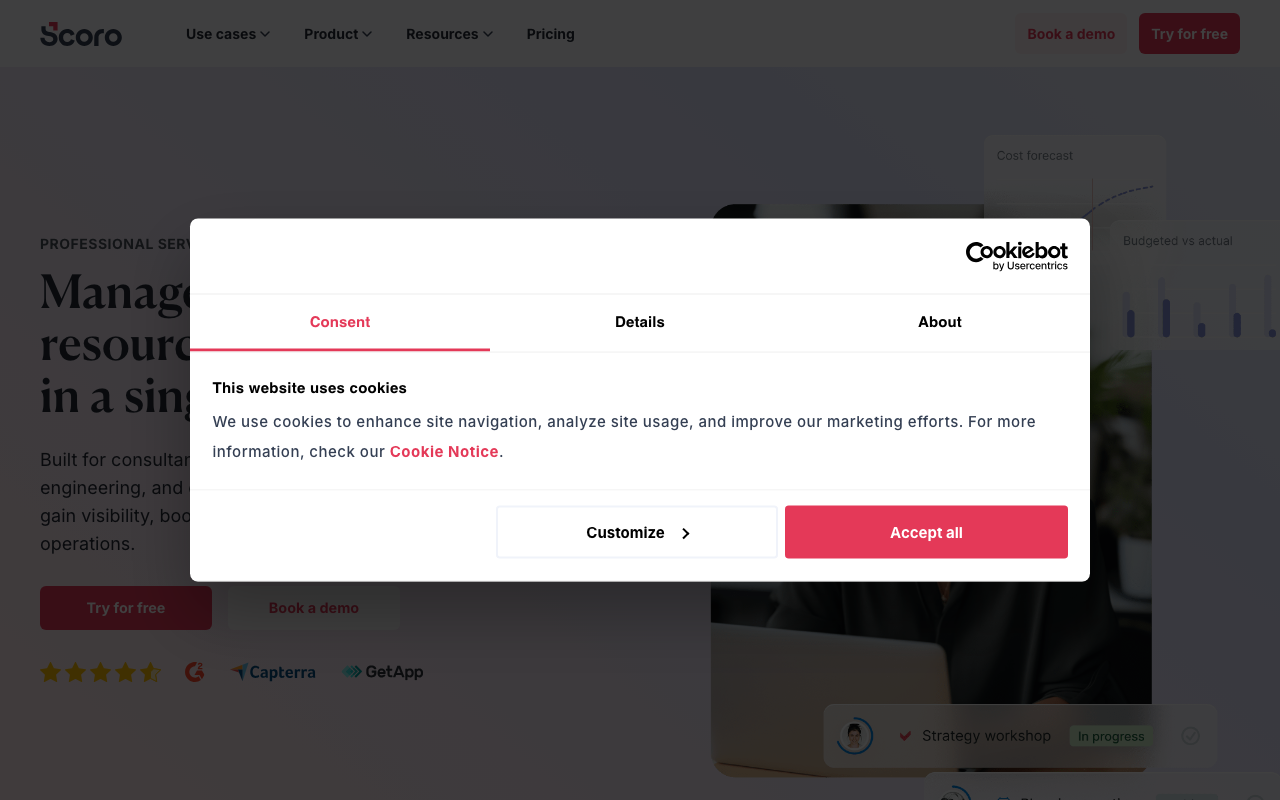
Scoro is a professional services automation (PSA) platform built for agencies, consultancies, and project-based service firms that want to consolidate their fragmented stack — project management, CRM, billing, time tracking, and resource planning — into a single system. Founded in 2013 and headquartered in Tallinn, Estonia (with offices in London and New York), it targets mid-size service businesses that have outgrown simpler tools like Asana or Harvest.
What It Does
The platform covers a wide functional surface: task and project management with Gantt charts and Kanban boards, time tracking with utilization reports, capacity planning for resource scheduling, a built-in CRM with pipeline management and quoting, and a full financial layer covering invoices, bills, and expense tracking. Revenue recognition and project profitability reporting are available on higher tiers — this financial depth is where Scoro distinguishes itself from lighter project tools.
The client-facing layer allows you to share project progress, send quotes and invoices for approval, and collect e-signatures. It's functional but limited compared to dedicated client portal tools — think invoice delivery and status visibility rather than a rich, white-labeled collaboration workspace.
Pricing
Scoro uses per-user monthly pricing with a minimum of 5 users, meaning even small teams face a floor of around $130+/month. Plans run approximately:
- Essential — ~$26/user/month: core project management, time tracking, basic CRM
- Standard — ~$37/user/month: adds Gantt, resource planning, and more reporting
- Pro — ~$63/user/month: advanced financial reporting, revenue recognition, and API access
- Ultimate — custom pricing for enterprise needs
No free tier exists; a 14-day trial is available. The per-seat cost at scale adds up quickly for larger teams.
Integrations
Scoro connects with Xero, QuickBooks, FreshBooks, and Stripe for accounting and payments. CRM integrations include HubSpot and Salesforce. Productivity integrations cover Google Workspace, Microsoft 365, Jira, and Slack. Zapier and a REST API (Pro and above) handle the long tail. The integration depth is reasonable, though some connections require the higher-tier plans.
Strengths and Limitations
Scoro's biggest strength is the project-to-cash workflow: from initial quote through project delivery to final invoice, all in one place with profitability tracked throughout. Marketing agencies, IT consultancies, and management consulting firms tend to find the most value here, particularly once teams exceed 15–20 people.
The trade-off is complexity. Onboarding requires real time investment, and smaller teams often find the feature surface overwhelming relative to what they actually use. The client portal specifically is a secondary capability — if polished client collaboration, file sharing, or white-labeled portals are the primary use case, dedicated tools like Clinked, Moxo, or Huddle will serve better. Scoro is best evaluated as a PSA platform that happens to include client-facing features, not as a client portal platform with project management bolted on.

James Whitfield
Accounting & Finance Editor
Last verified: 2026-02-25
Compare Scoro
Related tools