OnRamp
Customer onboarding software that automates implementation workflows
Pros
- ✓ Highly focused on reducing time-to-value for SaaS implementations
- ✓ Dynamic plans adapt based on customer responses and configurations
- ✓ Clean customer-facing experience that reduces implementation complexity
Cons
- ✗ Premium pricing aimed at enterprise SaaS companies
- ✗ Relatively new product with a smaller customer base
- ✗ Best suited specifically for SaaS — less applicable to other industries
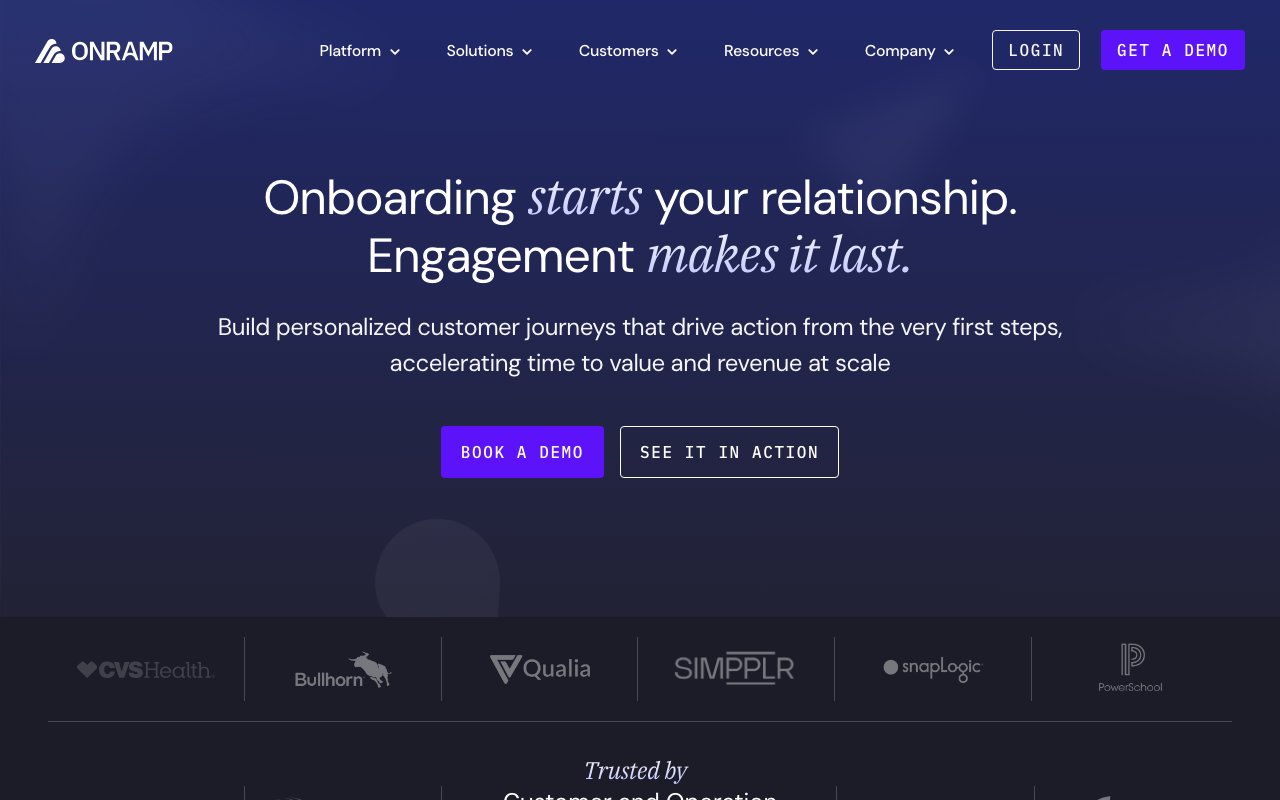
OnRamp is a customer onboarding and engagement platform aimed at SaaS companies running structured, high-touch implementation workflows. Rather than a generic project portal, it's built specifically around the concept of onboarding "playbooks" — repeatable templates that guide both customers and internal teams through the same multi-step process at scale.
Core approach
OnRamp centers on two layers: a customer-facing portal and an internal workflow engine. Customers see a branded, mobile-responsive portal with personalized task lists, milestones, embedded instructions, and real-time progress visibility. Internally, CS and implementation teams manage multiple concurrent onboarding projects from a unified dashboard, with task dependencies, auto-assignments, conditional logic, and role-based access controlling what each user type sees.
The platform dynamically tailors each customer's journey based on their company profile, role, and interaction history. If a customer indicates they're using a specific integration during intake, their onboarding plan can automatically route them to the relevant setup steps — skipping irrelevant ones.
Automation and AI
OnRamp leans heavily on rule-based and AI-driven workflow automation. Projects can be triggered automatically when a deal closes in Salesforce or HubSpot, with contact and account data synced in real time. The platform also surfaces bottleneck detection and completion risk alerts before they become problems, and includes AI-powered reporting that tracks onboarding velocity and capacity by project, role, or team member.
Integrations and compliance
Native CRM integrations with Salesforce and HubSpot are available on higher tiers, enabling auto-project creation from closed-won opportunities. OnRamp is SOC 2 Type II certified and offers SLA-backed uptime, which matters for enterprise buyers. Data collected during onboarding can be pushed as structured records to CRMs, project tools, and other systems of record.
Pricing
OnRamp uses a tiered subscription model, though specific dollar amounts aren't published — pricing is scoped based on onboarding volume, team size, and playbook complexity. There are four tiers: a Starter plan for lighter customer loads, a Growth plan aimed at mid-market teams that adds integrations and automation, a Scale plan for larger organizations needing deeper CRM connectivity and support, and an Enterprise plan for high-volume operations requiring maximum flexibility. All plans include a baseline of user roles, active customer accounts, and playbooks, with the option to add more of each. No free tier is offered, but OnRamp often provides a sandbox trial after an initial sales call to confirm fit before purchase.
Results and customers
Published customer outcomes include a 53% reduction in time-to-go-live at Qualia (with 3x onboarding scale in under a year), 75% improved time-to-activation and 85% onboarding efficiency gains at A2Z, and a 70% reduction in onboarding time at Flosum using seven repeatable playbooks. These metrics position OnRamp as a strong fit when implementation cycles are long, involve many internal stakeholders, and create measurable drag on revenue recognition.
Limitations
OnRamp is purpose-built for SaaS implementation teams — it's less applicable to professional services firms, agencies, or industries where onboarding is less structured. Pricing is enterprise-oriented and not publicly disclosed, which makes it harder to evaluate without a sales conversation. The product is relatively young (founded 2020), so it has a smaller ecosystem and fewer third-party reviews than more established alternatives.

David Park
Enterprise & Compliance Editor
Last verified: 2026-02-25
Compare OnRamp
Read more
Related tools