HoneyBook
Clientflow management for independent businesses — proposals, contracts, and portals
Pros
- ✓ One of the most popular platforms for freelancers and creatives
- ✓ Interactive proposals and contracts are standout features
- ✓ Strong brand recognition and large user community
- ✓ Mobile app for on-the-go management
Cons
- ✗ Higher starting price than some competitors
- ✗ Limited customization of portal layout
- ✗ Not ideal for larger agencies or teams
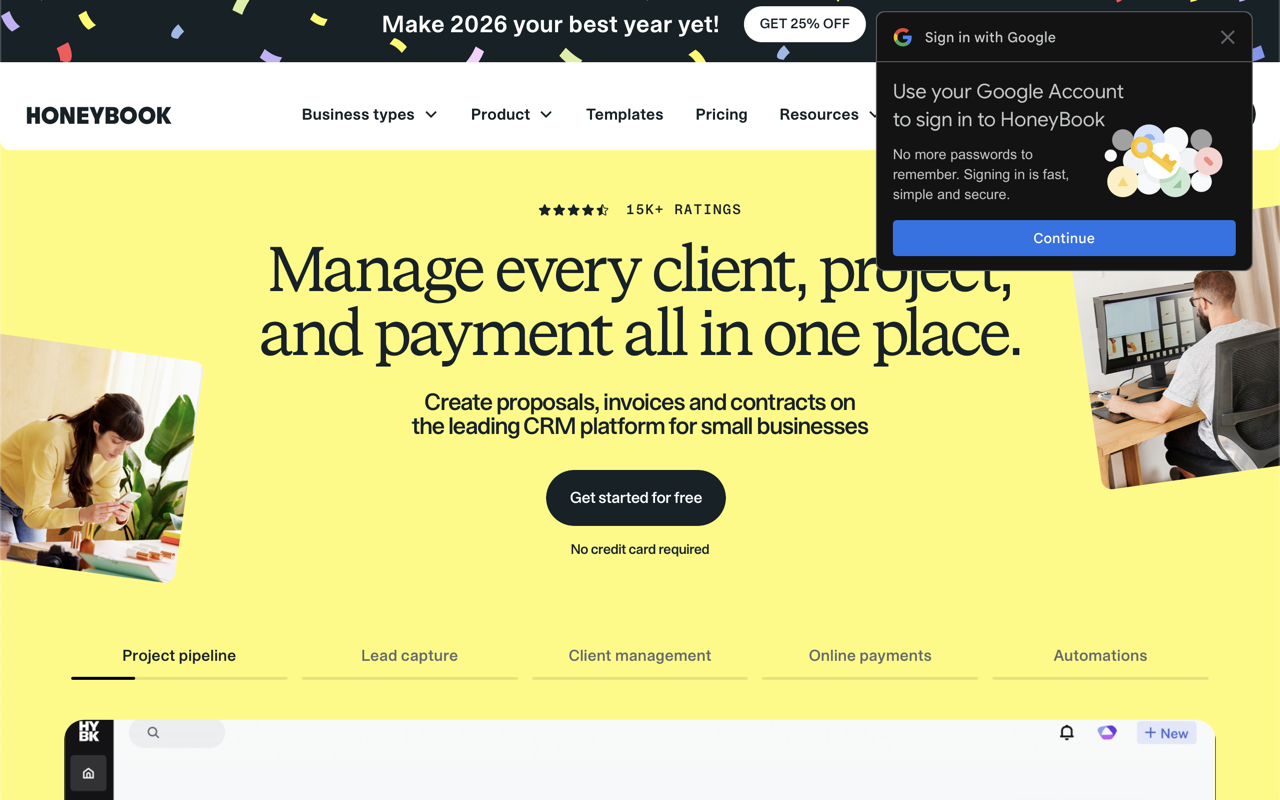
HoneyBook is an all-in-one CRM and client management platform built specifically for independent service businesses — photographers, event planners, designers, coaches, consultants, and similar solopreneurs. It combines lead capture, proposals, contracts, invoicing, and payments into a single workflow, with over 100,000 small businesses using it.
Who It's For
HoneyBook targets freelancers and small service businesses, not agencies or enterprise teams. The platform is intentionally narrow: it's designed around the client lifecycle from first inquiry to final payment, and that focus shows in the UX. If you run a solo or small-team service business and juggle multiple disconnected tools for scheduling, contracts, and invoicing, HoneyBook is designed to collapse that stack.
Core Features
The platform covers the full client lifecycle in one place:
- Lead capture: Embeddable lead forms (up to 2 on Starter, up to 10 on Essentials, unlimited on Premium) feed directly into the pipeline
- Proposals and contracts: Send a combined proposal, contract, and invoice in a single document — clients sign and pay in one step
- Invoices and payments: Online payment processing with automatic payment reminders
- Client portal: Clients get a dedicated space to view documents, sign contracts, and make payments
- Scheduler: Built-in booking calendar (Essentials and above)
- Automations: Trigger follow-up emails, reminders, and task sequences based on project milestones (Essentials and above)
- Pipeline/CRM: Visual project pipeline with task tracking across every client
HoneyBook AI is included on all plans and covers email draft generation, meeting note-taking, project summaries, and business trend insights.
Pricing
All plans include unlimited clients and projects and start with a free trial and a 60-day money-back guarantee.
| Plan | Monthly | Annual |
|---|---|---|
| Starter | $36/mo | $29/mo |
| Essentials | $49/mo | $36.75/mo |
| Premium | $109/mo | $81.75/mo |
Starter covers the basics: invoices, proposals, contracts, client portal, calendar, and HoneyBook AI — but no automations, no scheduler, and the "Powered by HoneyBook" branding stays. Essentials adds automations, the scheduler, QuickBooks Online sync, SMS reminders, white-labeling, and up to 2 team members. Premium unlocks unlimited team members, multiple company profiles, priority support, and advanced reporting.
Integrations
Native integrations are limited but cover the most common friction points: QuickBooks Online (Essentials+), Google Calendar, and Zoom. HoneyBook doesn't publish a broad integration directory — users who need deep connections to project management tools or marketing platforms will likely need Zapier.
Limitations
HoneyBook's strength is also its constraint: it's purpose-built for service businesses with straightforward client relationships. It's not suited for businesses that need complex project management, retainer billing with detailed time tracking, or multi-client collaboration on shared workspaces. Team features are also limited until Premium — the Essentials plan caps at 2 team members, which will be a blocker for growing agencies.
The platform doesn't appear to pursue enterprise compliance certifications (SOC 2, HIPAA), which matters for businesses handling sensitive client data in regulated industries.
Bottom Line
HoneyBook makes the most sense for solo and small-team service businesses — particularly creatives and consultants — who want to replace a patchwork of Calendly, DocuSign, PayPal, and spreadsheets with a single tool. The Essentials plan at $36.75/month annually is the practical entry point once you factor in automations and white-labeling. For teams larger than two or businesses that have outgrown the freelancer model, the jump to Premium at $81.75/month is steep relative to competitors that offer more flexible team pricing.

Sarah Chen
Agency & Freelancer Tools Editor
Last verified: 2026-02-25
Compare HoneyBook
Related tools