Caspio
Enterprise no-code platform for database-driven portals
Pros
- ✓ Enterprise-grade with 25 years of maturity
- ✓ HIPAA compliance available for healthcare portals
- ✓ Embeddable datapages can be added to any existing website
- ✓ Handles very large datasets without performance issues
Cons
- ✗ Builder UI has a steep learning curve
- ✗ Visual design requires more effort than modern no-code tools
- ✗ Pricing can scale quickly with data volume
Caspio is a long-running low-code platform — founded in 2000, one of the oldest in the space — used by over 15,000 organizations to build custom database-driven applications. Within the client portal context, it's important to understand what Caspio actually is: not a turnkey portal product you configure, but a full application-building platform where you construct the portal yourself using visual tools. The distinction matters when evaluating fit.
What You're Building With
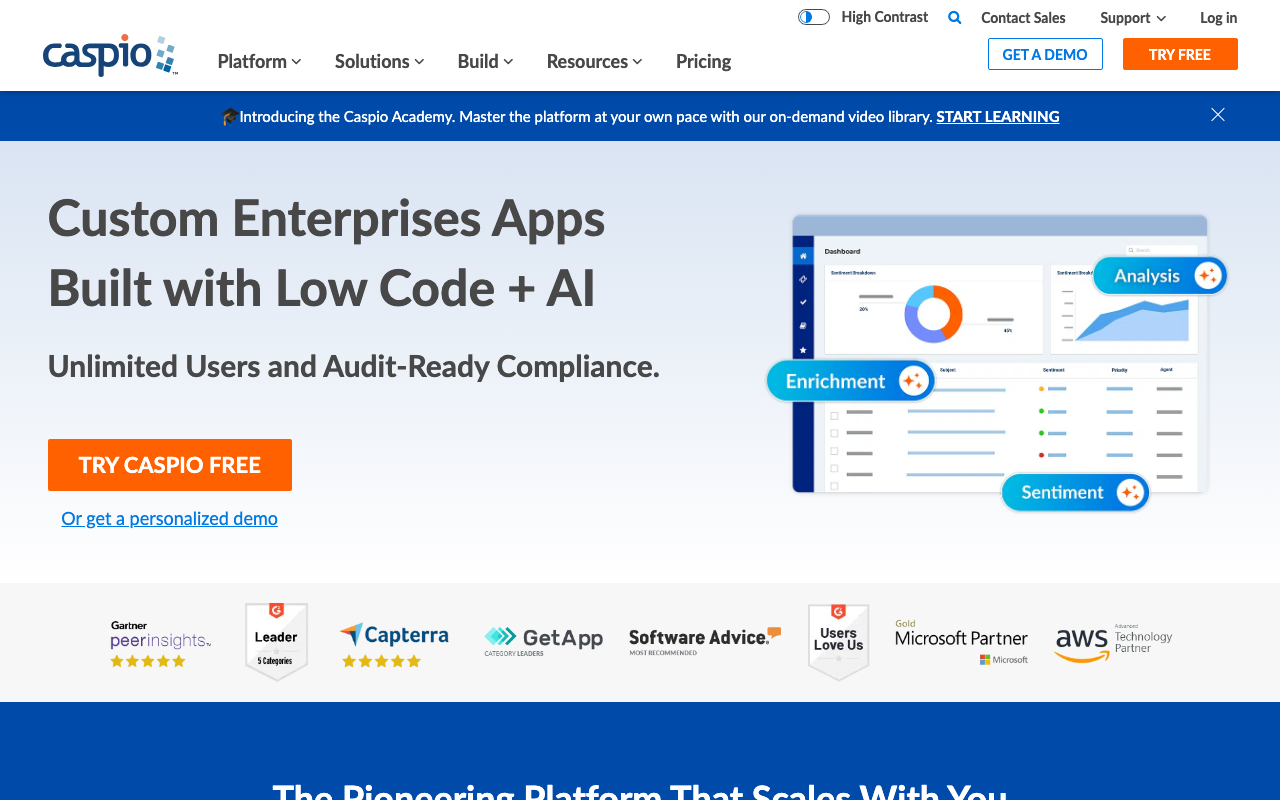
The core building blocks are called DataPages and DataParts — reusable interface components (forms, reports, charts, calendars, search queries, drill-downs) that connect to an underlying SQL database hosted on AWS with Microsoft SQL Server. Caspio offers two development frameworks: Bridge, the mature option with the full feature set, and Flex, a newer visual development environment. Both are included at no extra cost on any plan.
The AI capabilities layer in OpenAI/ChatGPT integration for natural language app building, automated data enrichment, and workflow acceleration. It's positioned as accelerating development rather than replacing it — you still need to understand what you're building.
Unlimited User Pricing
Caspio's most distinctive feature is its pricing model: no per-seat fees for end users. All plans include unlimited external users accessing deployed applications — whether that's 50 clients or 50,000. Builder seats (the people constructing and managing apps inside Caspio's platform) are the limited resource, not end users. For organizations building portals for large or variable client bases, this removes one of the most frustrating scaling dynamics in SaaS tools.
Plans
Caspio offers four tiers — Lite, Plus, Business, and Enterprise — though specific dollar amounts aren't listed publicly and require a free trial signup or direct inquiry. The tiers differentiate on:
- DataPages/DataParts count — the number of interface components you can deploy
- Data records capacity — total records across all database tables
- Automations — event-triggered and scheduled task complexity
- Identity management depth — 2FA, SSO (SAML/OAuth), white-labeled emails, and federation with external services like HubSpot, Slack, and Zoom appear at higher tiers
- Compliance infrastructure — HIPAA/compliance accounts on isolated infrastructure with BAAs require Plus or higher
- Support — 24/7 live chat and 24/5 phone support across plans; dedicated customer success managers at Enterprise
- Snap backups — Enterprise gets 5-minute interval snapshots vs. standard backup windows on lower tiers
Compliance and Security
This is where Caspio differentiates most clearly from lighter no-code competitors. Certifications include HIPAA, SOC 2 Type II, GDPR, and FERPA. HIPAA accounts run on separate infrastructure with Business Associate Agreements. All data is encrypted at rest, and higher tiers add full audit logging of read/write/edit/delete activity through deployed applications and APIs. For healthcare, government, financial services, and education use cases, these aren't checkboxes — Caspio treats compliance as core infrastructure.
Integrations
Native payment processing via Stripe and PayPal (Bridge framework). Native connectors for scheduled data import/export via cloud repositories. REST APIs, webhooks, and Zapier for connecting external systems. A marketplace of extensions and customizations built by the Caspio partner ecosystem.
Who It Fits
Caspio works best for organizations that need fully custom, compliance-grade applications and have the internal capacity — either low-code-savvy operations staff or developers — to build them. Real customer examples include logistics tracking systems deployed in two weeks (tracking 300+ trucks carrying 6,000 tons of supplies), custom CRM and quoting systems that reduced reporting time by 80%, and patient intake portals across healthcare networks.
It's overkill for teams that need a simple branded portal for document sharing or project status updates. The learning curve is real, and the Caspio Academy, certifications, and professional services offerings exist for a reason — customers typically invest time in the platform before getting production-grade results.
Limitations to Consider
Pricing opacity is a friction point — no public rates means every comparison requires a discovery call or trial period. The complexity of the platform also means slower time-to-value compared to purpose-built portal tools like Clinked or Content Snare. And while the unlimited-user pricing is attractive in theory, higher tiers gate significant functionality (SSO, compliance infrastructure, advanced automations), so the effective cost of a production-grade deployment is higher than entry-level pricing suggests.
Bottom Line
For regulated industries building applications where compliance, security, and scale are non-negotiable, Caspio's 25+ year track record, infrastructure credentials, and unlimited-user model make a strong case. For teams that just need a portal, the investment in learning and configuration is likely disproportionate to the need.

David Park
Enterprise & Compliance Editor
Last verified: 2026-02-25
Compare Caspio
Related tools