Budibase
Open-source platform for building internal tools and portals
Pros
- ✓ Open source — self-host for free with no user limits
- ✓ Connects to external databases directly (Postgres, MySQL, etc.)
- ✓ Active open-source community and rapid development
- ✓ Self-hosting gives full data control
Cons
- ✗ Primarily designed for internal tools — client portal patterns take more setup
- ✗ Cloud pricing can be expensive at scale
- ✗ Smaller ecosystem than proprietary competitors
- ✗ Self-hosting requires DevOps knowledge
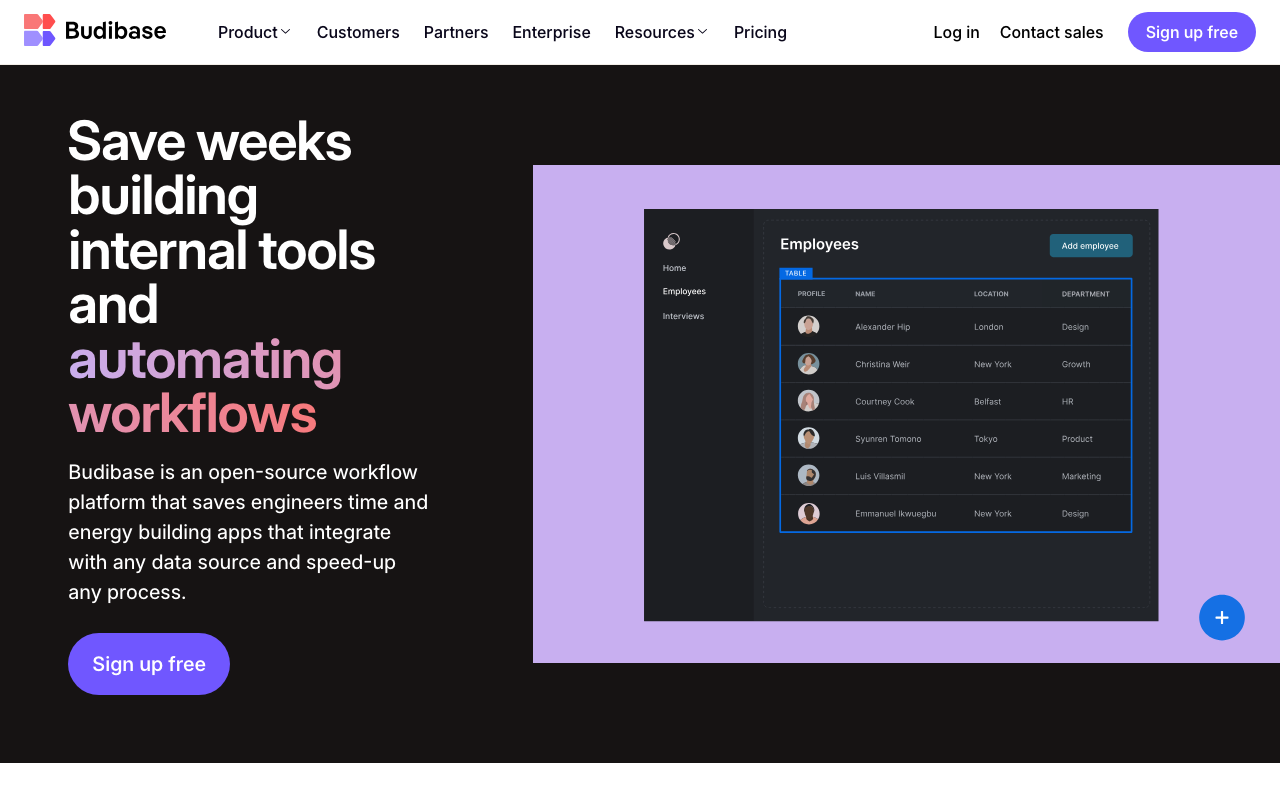
Budibase is an open-source low-code platform for building custom apps, portals, and internal tools. Unlike dedicated client portal products, it's a general-purpose builder — you create exactly the portal you need by connecting to your own data sources and composing screens visually. The self-hosted option with no per-user limits makes it one of the more cost-effective paths for organizations with large user bases or strict data residency requirements.
How it works
You build apps in a visual drag-and-drop editor, either against Budibase's own built-in database or by connecting to an external data source. From there you configure role-based access control, wire up workflow automations, and deploy. Apps can be embedded externally or accessed standalone. The public API lets you use Budibase as a backend, and custom JavaScript can be added wherever built-in components fall short.
Data sources and integrations
The breadth of data connectors is a genuine differentiator. Budibase connects natively to PostgreSQL, MySQL, MongoDB, DynamoDB, Elasticsearch, CouchDB, ArangoDB, Firestore, Google Sheets, REST APIs, and S3 — plus its own BudibaseDB for greenfield builds. CSV uploads are supported for quick data imports. For auth, you can connect Auth0, Google OAuth, Microsoft OAuth, or Keycloak, and enterprise plans add SAML-based SSO. Automation actions can trigger Discord notifications, and the platform integrates with Jira Cloud via a community plugin.
Deployment targets include Docker Compose, Kubernetes, DigitalOcean, Linode, Google Cloud Run, and Azure App Service, giving operations teams multiple options for fitting Budibase into existing infrastructure.
Security and compliance
Budibase is ISO 27001 certified. Self-hosted deployments give you full control over where data lives. Enterprise plans layer on audit logs, backups, and more granular RBAC. SAML and SSO are available at higher tiers. The open-source codebase (GPLv3 licensed) means security teams can inspect the code directly — a meaningful advantage for regulated industries or government deployments.
Who it's for
Budibase is best suited to technical teams — developers, IT departments, and DevOps engineers — who need custom portal or internal tooling without writing everything from scratch. It's been adopted by organizations building client-facing portals, vendor portals, approval workflows, admin panels, and data entry forms. Notable deployments include the Bulgarian Government (built and scaled an app to 100,000+ users in 4 days), Schnellecke (reported 90% faster internal tool delivery), and Reworld (projecting $3M in annual savings from reduced data entry).
It's less suited to non-technical users looking for a turnkey client portal. Setting up portal patterns — user invitations, branded login pages, document sharing flows — requires more configuration than a purpose-built product like Clinked or Huddle.
Pricing
Budibase's self-hosted tier is free and open source with no user limits, making it viable for large organizations willing to manage their own infrastructure. The cloud-hosted free tier covers up to 5 users. Paid cloud plans start at around $60/month for small teams and scale by user count. Enterprise pricing is custom and includes SSO, audit logs, priority support, and advanced RBAC. Nonprofit organizations are offered discounted pricing.
The self-hosted path meaningfully changes the economics: for teams with the DevOps capacity to run it, Budibase can be significantly cheaper than per-user SaaS tools at scale — but that operational overhead is real.
Limitations
The primary friction is that Budibase is a builder, not a finished portal product. Client-facing patterns (secure file sharing, client onboarding flows, proposal review) don't come out of the box and require assembly. Self-hosting also demands Docker/Kubernetes familiarity. The plugin ecosystem is smaller than Retool's, and the community plugin quality varies. For teams without development resources, there are more immediately deployable alternatives.

Tom Bradley
Senior Editor
Last verified: 2026-02-25
Compare Budibase
Read more
Related tools