AppSheet
Google's no-code platform for building apps from spreadsheets
Pros
- ✓ Tightly integrated with Google Workspace
- ✓ Very affordable per-user pricing
- ✓ Offline support for field workers
- ✓ Built-in ML and automation features
Cons
- ✗ Design customization is limited
- ✗ Primarily mobile-focused — desktop experience is secondary
- ✗ Google account required for authentication
- ✗ Complex apps can hit performance limits
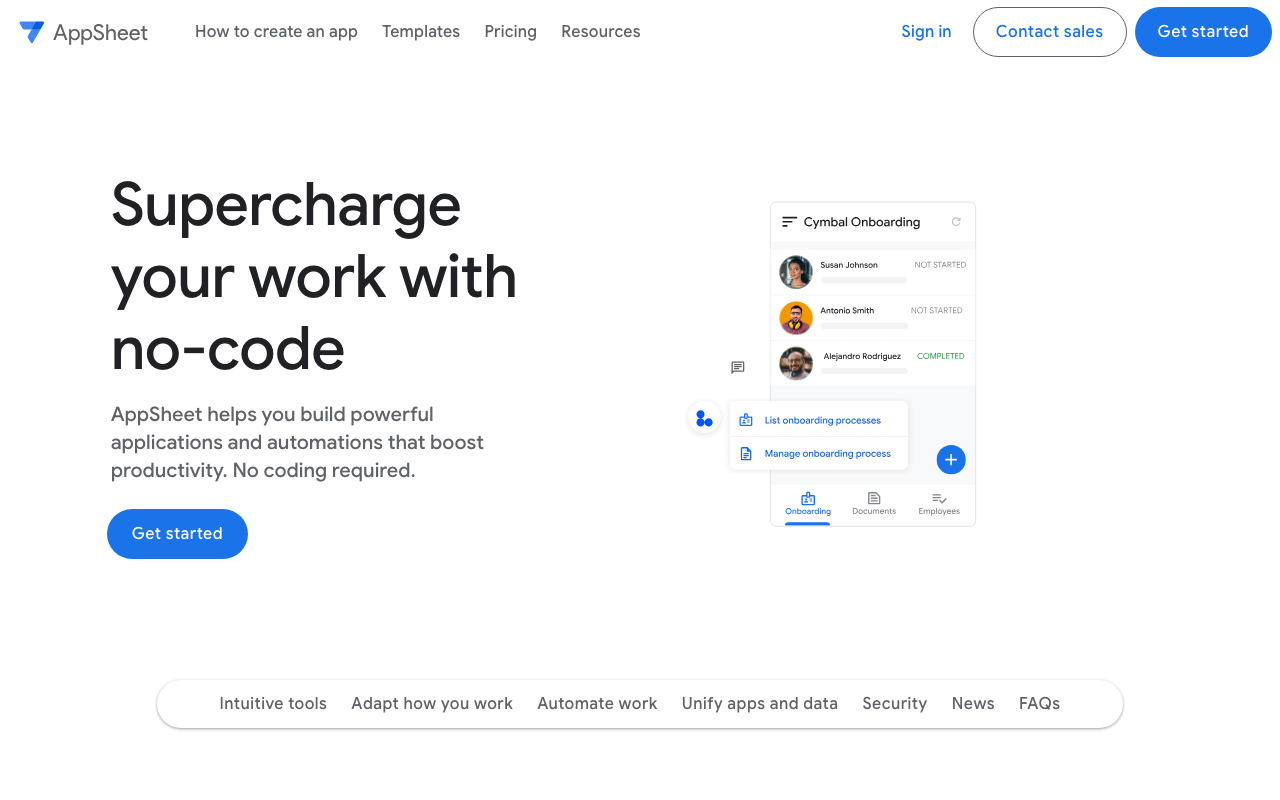
AppSheet is Google's no-code platform for building mobile and web apps from spreadsheets and databases. Acquired by Google in 2020, it sits inside the Google Workspace ecosystem and lets teams turn existing data sources into functional portals without writing code. Notable customers include Airbus, Carrefour Property, and Singapore Press Holdings.
How it works
You connect a data source — Google Sheets, Excel, BigQuery, SQL databases, or REST APIs — and AppSheet generates a working app automatically. From there you customize views, forms, and navigation, then layer in business logic using conditions, triggers, and branching workflows. The platform supports rich data capture including barcodes, GPS coordinates, digital signatures, photo uploads, and OCR for document processing. Automation bots handle notifications, scheduled actions, and data updates without any code.
Since 2023, AppSheet has integrated Google's Gemini AI: you can describe the app you want in plain language and Gemini generates the initial structure. AI features also extend into apps themselves — intelligent document processing and ML models can be embedded into workflows.
Data and integrations
AppSheet connects natively to the Google Workspace stack (Sheets, Drive, Gmail, Chat, Apps Script) and to Microsoft services including Office 365 and SharePoint. Third-party integrations include Salesforce, Dropbox, Apigee, and generic REST APIs with OData support. A notable design decision: AppSheet does not store or control your data — all data stays in your chosen backend, which matters for organizations with data residency requirements.
Pricing
AppSheet offers a free prototype tier for up to 10 test users. Paid plans:
- Starter — $5/user/month: basic app and automation features, connects to spreadsheets and cloud storage
- Core — $10/user/month: advanced features, application security controls, email support. Included in most paid Google Workspace plans, so many existing Workspace customers get this at no additional cost
- Publisher Pro — $50/month per app (unlimited users): for publicly accessible apps without user sign-in or security filters; useful for read-only portals
Enterprise plans with centralized governance policies, advanced security controls, and Zero Trust enforcement are available through Google Workspace agreements. Educational and non-profit organizations can apply for discounted pricing.
Limitations
The platform is primarily optimized for mobile-first use cases — the desktop experience is functional but clearly secondary. Design customization is constrained compared to dedicated portal builders; you work within AppSheet's UI paradigm rather than shaping a branded experience. Authentication runs through Google accounts, which works seamlessly inside Google Workspace organizations but creates friction for external clients without Google accounts. Complex apps with many columns, formulas, and large data sets can hit performance limits. The expression language for business logic has a learning curve that eventually makes "no-code" a bit of a stretch for advanced use cases.
Who it's for
AppSheet works best for Google Workspace shops that want internal operational portals — field service teams, logistics, facilities management, HR intake — where the goal is a functional tool built from existing spreadsheet data rather than a polished client-facing experience. Organizations already paying for Google Workspace Business Standard or higher effectively get Core tier access bundled in, making the cost equation compelling for internal use.

Tom Bradley
Senior Editor
Last verified: 2026-02-25
Compare AppSheet
Read more
Related tools